Carousel with slides shown at a time. Use the Previous and Next buttons to navigate.



Sustainability
The role of sustainability in our operations
GLS Poland is committed to operating in accordance with the principles of sustainable development
and ESG, combining care for the environment, social responsibility and governance. On our website, we provide an overview of the key initiatives that illustrate our commitment.
We strive to be transparent in our actions and ensure ethical conduct within the part of supply chain we are responsible for.
Our approach to environment
We care about our effect on the world around us. We know that every parcel, its logistics and transport processes have impact on the environment and cause carbon emissions. We want to continue our mission of connecting people around the world while gradually while reducing our impact on the environment.
In GLS Poland we are carrying out our Group-wide Environmental strategy that aims to reduce our greenhouse gas emissions and ensure that knowledge and efforts are shared across our entire international network.



ESG Report 2025
ESG Report 2024
ESG Report 2022
ESG Report 2020
Our path to net-zero*
As the GLS Group, we are committed to achieving net-zero* by 2045, in line with the Science Based Targets initiative.
GLS Poland is a subsidiary of GLS B.V. and is covered by GLS B.V.’s commitment under the SBTi. The SBTi targets apply to the entire GLS Group, are monitored at a consolidated level and do not constitute individual targets for subsidiaries such as GLS Poland. The performance of individual companies may exceed or fall short of the Group-wide targets, whilst the Group as a whole continues to strive to meet the consolidated emission reduction targets approved by the SBTi.
To this end, we have developed an Environmental Strategy which focuses on the gradual reduction of our emissions and on improving energy and resource efficiency across all GLS countries.
Electric and low emission vehicles** in our transport fleet
Share of electric vehicles in our transport fleet is constantly growing, which is a result of actions of our transport partners and our collaboration with them.
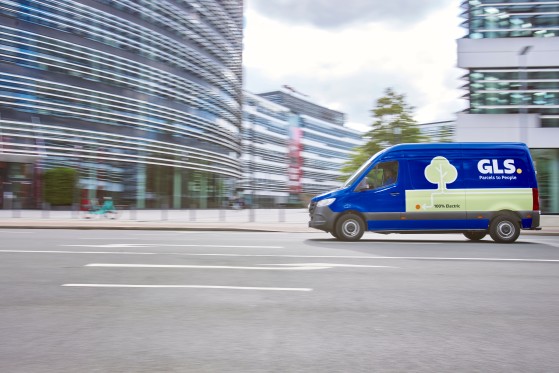
We are currently focusing on introducing electric vehicles for last mile delivery. At the end of 2025, we had 390 e-vans in operation, which represents 17,5% of the vehicles up to 3.5 tons in our transport fleet. On several international routes, in addition to diesel trucks, we utilize vehicles powered by LNG and HVO.
Electric cars in our company fleet
We are electrifying our company fleet and replacing hybrid and diesel cars with electric vehicles. We aim to have 100% electric company car fleet by 2030. At the end of 2025, we had 58 electric cars in use, representing 33% of our company fleet.
Cargo bikes in Polish cities
We have introduced 16 electric courier bikes in Poland’s largest cities, as of December 2025. They are used to deliver parcels in city centers and Low Emission Zones, where access for traditional vehicles is often restricted.
Charging infrastructure
We are investing in the expansion of charging infrastructure at our depots, which supports the transformation of our transportation and company car fleet.
Photovoltaic installations
We are investing in renewable energy sources. We have installed solar panels with a total capacity of 1200 kWp at 9 of our locations.
Environmental management system
All of our depots in Poland have implemented an environmental management system compliant with the ISO 14001 standard. This initiative helps us on a daily basis to effectively manage our environmental impact, comply with legal requirements and achieve our environmental goals. Our compliance with the requirements has been confirmed by DEKRA, a globally recognized audit organization.
Rankings and Certifications
We are committed to advancing ESG initiatives by actively participating in external certifications and assessments. This approach not only reinforces our commitments, but also provides valuable insights from independent experts. Their assessments enhance transparency and provide important feedback that helps us effectively implement our ESG strategy.



*GLS B.V. is committed to reduce its absolute Scope 1, 2 and 3 greenhouse gas emissions by 90% by 2045, using 2021 as the base year. The residual emissions will be neutralized. This means the business counterbalances up to 10% of its CO2e emissions with investments in carbon removal projects outside its value chain, in line with the SBTi Net-Zero Standard The Science Based Targets initiative commitment of GLS B.V. encompasses all affiliated companies of GLS B.V. operating under the GLS trademark. GLS Poland is a subsidiary of GLS B.V. and is included in GLS B.V.'s SBTi commitment. Group SBTs are monitored at the consolidated Group level and do not represent individual targets for subsidiaries, such as GLS Poland. These companies may perform above or below the Group targets, while the Group as a whole remains compliant with the overall consolidated Group SBTs.
**This means vehicles that during operation create either no emissions (e.g. electric or hydrogen vehicles) or fuels that create lower emissions than diesel- or gasoline fuel (e.g. natural gas, HVO, biogas).